Surface protection for Australian data centre construction

    Staged builds, clean-build protocols, heavy rolling loads and long programs. Protection supplied from Australian stock in project quantities, to the sequence your program actually runs.

    Australian-owned since 2017 · Leichhardt NSW · ships nationally · bulk and project pricing

    Australian data centres - Market snapshot

    Market snapshot - as at September 2026
    • ~165 operational

      Australian data centres in operation, with 225+ more proposed nationally, more than double the number a year earlier (AEMO 2026 Electricity Statement of Opportunities).

    • 5.4 GW in the connection queue

      eleven projects in AEMO's transmission connection queue, roughly 60% in NSW and 40% in Victoria (AEMO, June 2026).

    • 19 sites under construction

      totalling 1,853 MW nationally, concentrated in Western and Northern Sydney and Melbourne's west (Renewmap, May 2026) [CONFIRM: verify figure directly at renewmap.com.au — currently sourced via ITK Research's summary of Renewmap data].

    • A$20B and A$25B

      headline commitments to 2029: AWS A$20B (announced June 2025) and Microsoft A$25B (announced April 2026).

    Sources: AEMO 2026 Electricity Statement of Opportunities (operational and proposed counts, connection queue); Renewmap, May 2026 (sites under construction); AWS and Microsoft public announcements, June 2025 and April 2026.

    Where protection goes on a data centre build

    Data hall floors

    Raised access floor tiles and coated slabs take the brunt of mechanical and electrical fit-out, containment installation and rack delivery. Tile edges chip, coatings scuff and pedestal grid alignment suffers under repeated loading.

    What site usually requires: Full-coverage board or sheet across the hall, taped at joints, able to stay down for months and lift cleanly before information and communications technology equipment is installed.

    Typical spec: heavy-duty corrugated protection board laid wall to wall over the access floor, joints taped, edges dressed into wall protection.

    Impact Protection Boards

    [CONFIRM: flame-retardant rating of each floor product - data centre fire engineering often requires flame-retardant temporary materials. Do not state an Australian Standard 1530.3 or equivalent rating unless confirmed against product documentation.]
    Raised-floor electrostatic discharge considerations

    Static-sensitive equipment is staged and installed on the same floor that has been covered for months. The site's electrostatic discharge plan governs what may remain in the hall when racks are installed.

    What site usually requires: Agreement with the site's electrostatic discharge lead on what protection stays down, and when it is removed relative to first energisation.

    Typical spec: protection removed and the floor cleaned down before rack install, unless a static-dissipative product is confirmed for the zone.

    Loose Lay Surface Protection

    [CONFIRM: whether any Honcho floor protection is static-dissipative. If not, state plainly that products are not rated for electrostatic discharge and recommend consulting the site's electrostatic discharge plan before rack install.]

    Plant rooms, switchrooms and battery rooms

    Resin floors and finished concrete slabs are exposed to cable drums being dragged, tools dropped from ladders and elevated work platforms, and hot works during electrical fit-out.

    What site usually requires: Impact-rated board where drums and plant are moved, plus a heat-tolerant layer wherever cutting or welding occurs.

    Typical spec: heavy-duty board over the traffic routes and set-down zones, with dedicated hot-works protection at each welding location.

    Specialty Concrete Protection

    [CONFIRM: heat and weld-splatter suitability of the nominated products.]

    Corridors, loading docks and lift cars

    The haul route from dock to hall carries every pallet on the job. Corridor floors, door frames, corners and lift car walls and floors absorb repeated knocks.

    What site usually requires: A continuous protected route: floor protection through corridors, corner and jamb protection at every turn, and full lift car lining.

    Typical spec: walkway matting or board along the haul route, corner guards at pinch points, door protection at each opening, and lift car floor and wall protection maintained for the duration.

    Pedestrian & Safety Walkway Mats

    Walls, partitions and glazing

    Hall partitions, pressure-rated and blast-rated doors, and security glazing at mantraps are installed early and live with trades around them for months.

    What site usually requires: Adhesive films on glazing, corner guards on exposed returns, and jamb protection on every rated door leaf and frame.

    Typical spec: protective film to glazing, corner guards to partition returns, and door and jamb protection retained until commissioning.

    Glass Protection

    [CONFIRM: film residue behaviour on powder-coated and stainless finishes, and maximum recommended dwell time.]

    Stairs and handrails

    Multi-storey facilities run trades up and down the same cores for the whole program. Treads, nosings and handrail finishes wear and chip.

    What site usually requires: Tread and nosing protection on all trade-access stairs, plus handrail and balustrade covers.

    Typical spec: fitted tread and nosing protection to every trade stair, rail guards to finished handrails.

    Rail Guards

    Dust and containment

    Clean-build zoning fails where a barrier is missing. Dust migration into a hall that has moved to controlled cleanliness costs programme time to remediate.

    What site usually requires: Temporary dust barriers, zip doors and floor-to-ceiling sheeting at every zone boundary.

    Typical spec: sheeting and framing at zone boundaries, zip-door entries at controlled access points.

    Tape

    [CONFIRM: product availability in this category - dust barrier, zip door and sheeting lines are not currently listed.]

    External and civil

    Hardstand, kerbs and completed landscaping are exposed to heavy vehicle movements and crane set-downs right through the program.

    What site usually requires: Trackway and hardstand protection on heavy vehicle routes, plus hoarding around completed works.

    Typical spec: protection to kerb lines and completed landscaping, hoarding to finished external works.

    Temporary Adhesive Mats

    Comparable projects

    No data centre project is shown here yet. This is the most relevant indoor commercial slab protection project from our gallery.

    Concrete surface protection in Bondi
    Concrete surface protection in Bondi

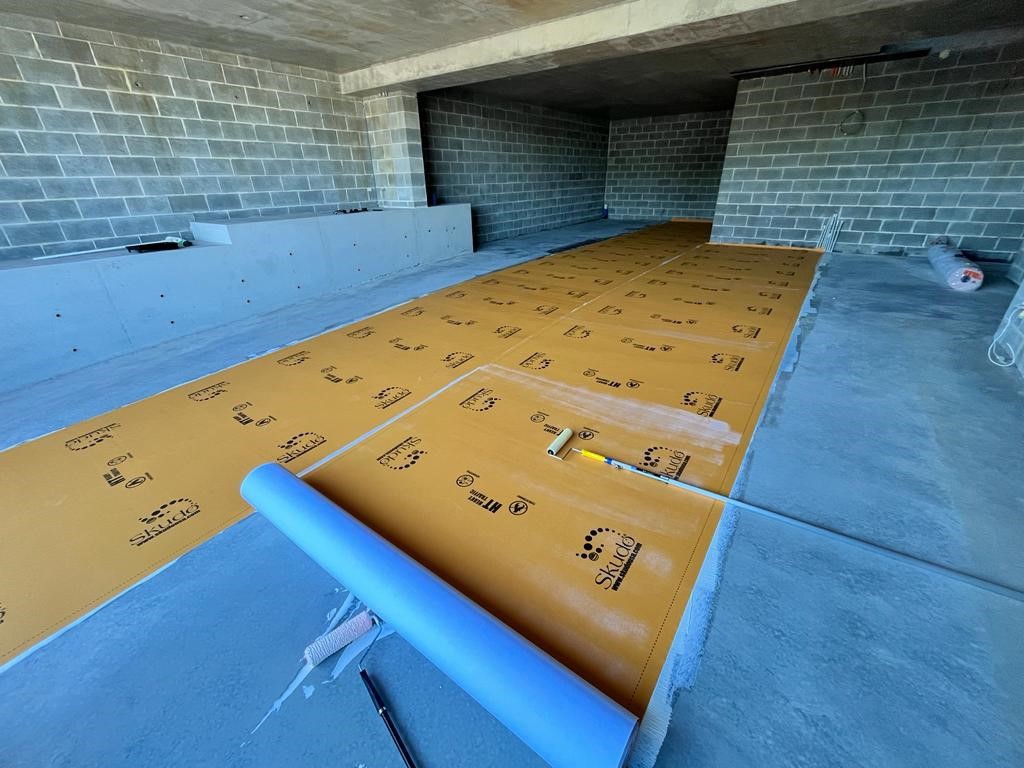
    BWG - Bondi: Skudo HT Commercial System protecting basement slab from stains and materials.

    [CASE STUDY: data centre or comparable critical-facility project - requires confirmed client permission before naming.]

    Built for project procurement

    • Project quantities and staged deliveries aligned to the fit-out program.
    • Consolidated invoicing across stages and packages.
    • Product data sheets and SDS available on request. [CONFIRM: which products have SDS on file.]
    • Consistent supply across a multi-year program, same product, same batch behaviour.
    • Australian stock, not import lead times. [FLAG: confirm which lines are stocked vs indent.]

    Tender and supply questions

    Is there a minimum order quantity for project supply?

    No fixed minimum for project supply. Pricing is set against the schedule and the staged call-off, so the quote reflects the whole program rather than a single drop. Small top-up orders can be placed against the same project reference.

    What are lead times to Western Sydney compared with Melbourne?

    Stocked lines dispatch from Australian warehousing and are quoted with a delivery window per drop at the time of order. [FLAG: freight - confirm current lead times to Western Sydney and to Melbourne's west before publishing.] [CONFIRM: freight lead times per corridor.]

    Can protection stay down for 12 months or more and still come up without residue?

    Removal behaviour depends on the product, the substrate and the dwell time. Adhesive films and tack mats have a recommended maximum dwell period, and loose-lay board has none. Confirm the intended duration at quote so the right product is specified for the stage. [CONFIRM: maximum dwell time and residue behaviour per product on coated slab, resin, raised access floor tile and powder-coated finishes.]

    Is flame-retardant documentation available for temporary protection materials?

    Fire engineering on data centre projects commonly restricts what temporary material may remain in a hall. [CONFIRM: which products hold flame-retardant test documentation and which standard each was tested to. Do not state a rating until it is verified against product documentation.]

    Can Honcho supply against a schedule rather than one purchase order?

    Yes. A schedule can be loaded against the project and released stage by stage, with each drop referenced to the level, hall or package so site can reconcile deliveries.

    Is the protection suitable over raised access floor tiles?

    Loose-lay board is the usual approach over an access floor because it spreads point loads without bonding to the tile surface. Pedestal grid loading and any ESD requirement must be checked against the site engineer's advice before install.

    Can unused stock be returned at the end of a stage?

    Unopened, undamaged stock in original packaging can generally be returned by agreement, subject to freight back and a restocking assessment. Agree the position in writing at order stage on long programs.

    Who specifies the protection on a data centre package?

    Usually the head contractor sets the site protection requirement and each subcontractor is responsible for their own work face. Honcho can price both the head contract allowance and the individual package so the two align.

    Price the protection with the program

    Send the stage dates and areas and we will price the protection against the schedule, not a single drop.

    Call 1300 038 244